
A Brass Monkey cold plunge at a residential villa in Jumeirah Golf Estates arrived at a standstill: the touchscreen was completely unresponsive, the blue tub light was flickering intermittently, and the unit had sat unused for approximately eight weeks. The owner’s first concern was that the chiller itself had failed. A structured Brass Monkey cold plunge repair diagnostic told a different story. Every mechanical and refrigeration component - fan, compressor, coil, and pump - tested operational when driven directly. The fault was electrical, isolated to the screen-side circuit, and almost certainly the product of circuit degradation during the idle period rather than any physical damage. Repair scope was defined, quoted, and the hardware confirmed salvageable within a single visit. This case study documents how the fault was found, what caused it, and what prevents it from happening again.
The Unit and the Problem
The unit is a Brass Monkey cold plunge, a UK-manufactured ice bath with an integrated chiller, recirculating pump, UV sterilisation lamp, and a touchscreen controller that manages temperature scheduling, filtration cycles, and maintenance alerts via a companion app. The model is designed for residential use and is well suited to villa environments across Dubai and its wider communities.
On arrival at the Jumeirah Golf Estates property, the technician found the unit powered but the touchscreen showing no response to input. The blue ambient tub light, which is controlled through the same electrical circuit as the display, was flickering rather than holding a steady state. The unit had been idle for approximately eight weeks, powered down or left in standby while the owner was away.
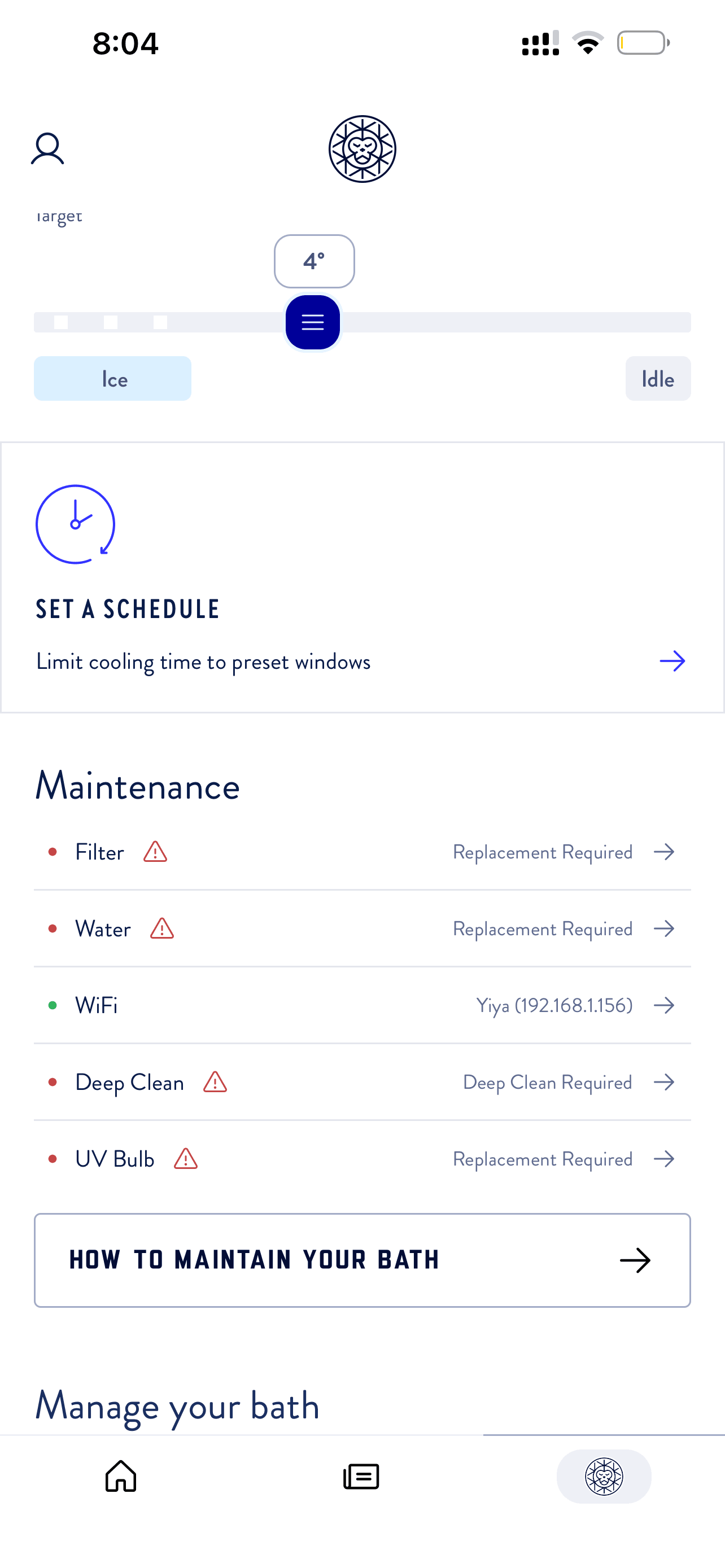
When the Brass Monkey companion app was opened, it immediately flagged four maintenance alerts: filter replacement required, water replacement required, deep clean required, and UV bulb replacement required. These alerts are consistent with the manufacturer’s expected service intervals and align directly with an eight-week idle period. The app also showed the unit in an idle state with a 4°C target temperature set but no active cooling cycle running.
The owner’s assumption was a chiller fault. This is the most common first conclusion when a cold plunge stops producing cold water, and it is understandable. Chiller failures are not rare in Dubai’s climate. In this case, the symptom profile pointed elsewhere from the outset. A failed compressor or refrigerant leak does not typically produce a dead touchscreen and a flickering indicator light. Those symptoms point to the electrical supply or control circuit serving the screen and its downstream components, not the refrigeration loop itself.
The scope on arrival therefore covered two parallel tracks: confirm refrigeration and pump integrity through direct bypass testing, and trace the electrical fault from the plug and supply cable through to the screen PCB and its associated circuit. Both tracks needed completing before any repair cost could be quoted accurately.
Diagnostic and Root Cause
The technician began with a bypass test of the core mechanical components. By driving the fan, compressor, coil, and pump directly, bypassing the screen controller entirely, it was possible to confirm whether the refrigeration and hydraulic systems were intact before spending time on the electrical circuit. All four components responded correctly. The compressor started cleanly, the fan ran at rated speed, the coil showed no signs of ice blockage or refrigerant starvation, and the pump circulated water through the filtration loop without cavitation or flow restriction.
This was the critical finding of the diagnostic. It meant the unit’s core function was intact. The fault was not a compressor failure, a refrigerant leak, a blocked expansion valve, or a pump seizure. It was confined to the electrical pathway serving the screen and the control circuit that connects the screen to the rest of the unit.
Attention then moved to the supply side. The existing plug was opened for inspection.
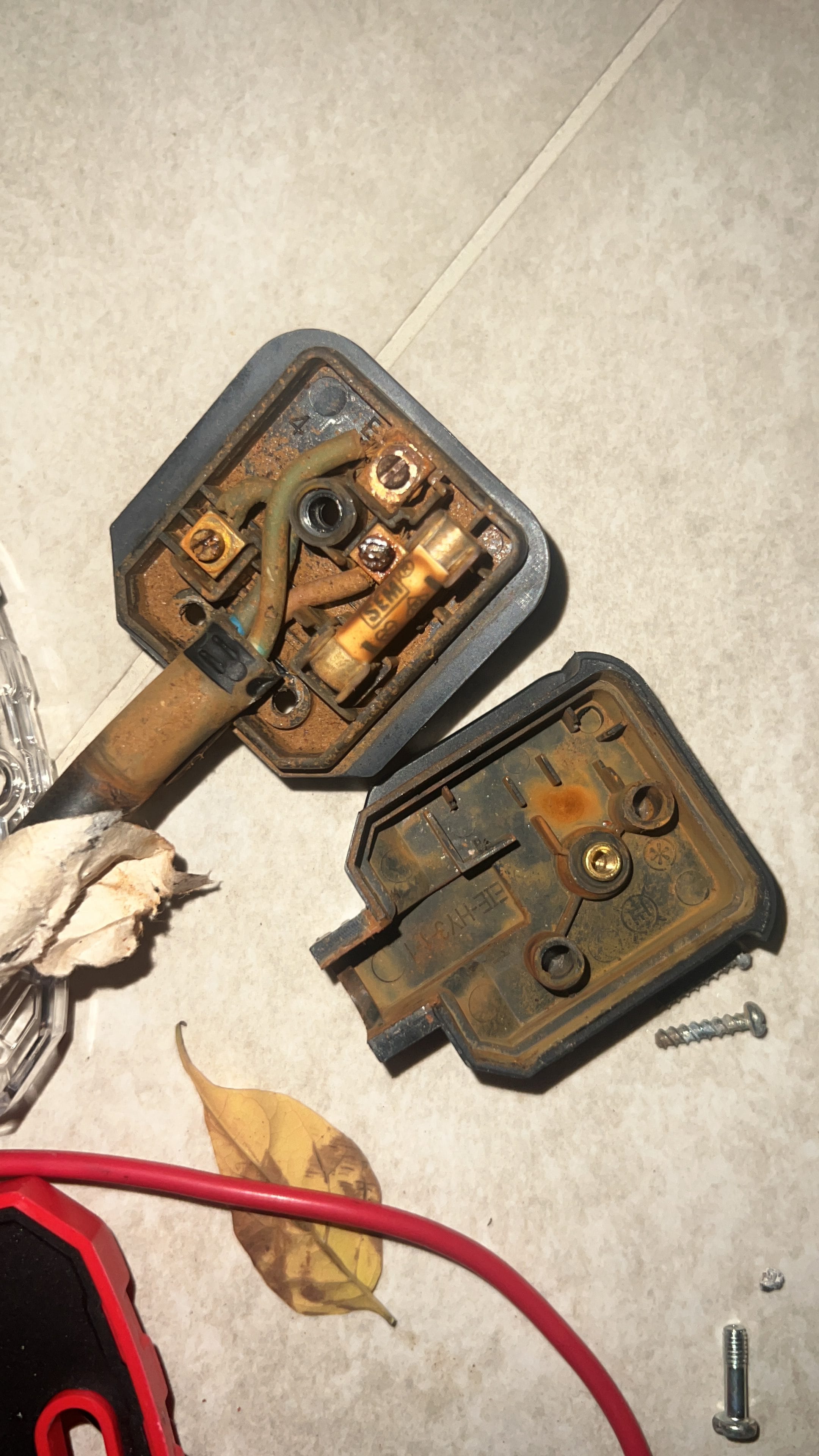
The plug internals showed significant corrosion across all three terminal connections: live, neutral, and earth. The fuse holder had oxidised. The wire insulation showed discolouration consistent with prolonged moisture exposure. This level of corrosion in a mains plug is a measurable resistance increase at each terminal junction. Under normal load the unit may still power on, but the voltage drop introduced by corroded contacts is enough to starve a low-draw control circuit, such as the screen PCB and its backlight driver, while leaving higher-draw components like the compressor and pump drawing sufficient current through a different path.
This mechanism explains the symptom pattern precisely. The compressor and pump, being high-current loads, were able to maintain operation intermittently. The screen, running on a stepped-down supply through its own regulation circuit, could not maintain stable voltage and dropped out entirely. The flickering tub light, also on the screen-side electrical feed, was showing the same instability.
The root cause assessment points to the idle period as the primary driver. Eight weeks of inactivity in a Dubai outdoor or semi-outdoor environment allows condensation to accumulate in any unsealed electrical enclosure. The plug had no moisture protection beyond its standard plastic housing. Repeated thermal cycling between cooler nights and hot days drives moisture into small gaps. Without the warmth generated by normal operational current flow, the moisture sits and accelerates oxidation. The manufacturer app data corroborated this timeline: all four maintenance flags were consistent with an eight-week gap, not with an acute failure event.
The screen PCB itself required further assessment to determine salvageability. A replacement screen is sourceable from the manufacturer within seven days if the PCB cannot be recovered. That confirmation was deferred pending completion of the electrical work upstream, as there is no value in testing a PCB while its supply circuit remains compromised.
The Work
The repair scope was defined across five discrete work items, all identified during the single diagnostic visit and quoted before any remediation work began.
First, an isolator was specified for installation ahead of the unit’s supply cable. A dedicated isolator allows the unit to be fully de-energised without disturbing the mains circuit, which is both a safety requirement for ongoing service work and a protection measure against the kind of partial-power idle state that contributed to this fault. Cold plunges in residential settings are frequently left in standby rather than properly isolated, and a fitted isolator removes that ambiguity.
Second, the existing plug was removed and condemned. Given the corrosion level visible at all three terminals and the fuse holder, refurbishment was not appropriate. A corroded earth terminal in a unit handling water is a safety hazard, not a tolerable degradation. The replacement plug was fitted with correctly rated conductors and torqued terminals.
Third, the main supply cable was assessed along its full run for signs of insulation damage, kinking, or moisture ingress at the unit entry point. Cable condition at the gland entry on cold plunge units is a common secondary fault point, particularly where the cable exits through a surface that accumulates water or cleaning chemical residue. No additional damage was found on this unit beyond the plug end.
Fourth, filter replacement and UV lamp fitting were completed during the same visit. The Brass Monkey app had flagged both as overdue, and with the unit already drained down for electrical work, completing these items at the same time avoided a second attendance. The UV lamp on this unit operates on a run-hour counter; after the idle period the lamp had reached its replacement threshold without the owner being aware, as the app alerts only display when the unit is connected and the app is opened.
Fifth, the screen circuit diagnosis was initiated. With the supply side corrected, the PCB can be tested under stable voltage conditions. PCB salvageability was logged as pending confirmation. If the board has sustained damage from prolonged voltage starvation or moisture tracking across the circuit, a replacement screen assembly will be sourced from the manufacturer. Lead time is seven days. If the board is recoverable after supply restoration, no screen replacement is required. That determination follows the electrical remediation work.
Water maintenance, including the chemical deep-flush flagged by the app, was deferred until the electrical scope is completed. There is no technical value in refilling and treating water before the screen circuit is confirmed operational, as the unit cannot run a filtration cycle or UV sterilisation pass without a functioning controller.
The Outcome
At the close of the diagnostic visit, the position was as follows. All refrigeration and hydraulic components were confirmed working. The fault was isolated to the screen-side electrical circuit, with the corroded plug identified as the primary cause of the voltage drop. The repair scope was defined across five work items: isolator installation, plug replacement, cable assessment, screen circuit diagnosis, and consumable replacement. Filter and UV lamp were completed during the visit.
The owner had an accurate picture of what had failed, why it had failed, and what the repair would involve. The unit was not written off, and no major refrigeration components needed replacement. The total repair path from this point is a single return visit to complete the electrical work and confirm PCB status, followed by water maintenance and a full functional test.
For a Brass Monkey unit imported from the UK, getting accurate repair support in Dubai requires a technician familiar with the platform. The manufacturer’s app data proved useful during this job: the maintenance flags gave an independent confirmation of the idle timeline and helped narrow the fault category before the plug was even opened. Owners of Brass Monkey units in the UAE can contact Euphorium via WhatsApp for repair assessment or visit the cold plunge repair and installation page for full service details.
Why Dubai Conditions Cause This
Electrical degradation during idle periods is a predictable outcome in Dubai’s climate, and understanding the mechanism helps owners protect their units during any planned gap in use.
Dubai’s coastal and semi-coastal environment maintains relative humidity that regularly exceeds 80% during the summer months, particularly overnight. The UAE’s National Centre of Meteorology records sustained high humidity across the summer season from May through September, with overnight lows that can still carry significant moisture loading. Outdoor and semi-outdoor electrical enclosures, including plug bodies and cable glands, are not hermetically sealed. They rely on operational warmth from current flow to keep internal surfaces dry.
When a cold plunge is powered down or left in long-term standby, that warmth disappears. Each daily thermal cycle, warming through 40°C or above during the day and cooling at night, drives small volumes of humid air in and out of any gap in a plastic housing. Over eight weeks, this repeated process deposits enough moisture on metal surfaces to initiate and sustain oxidation. Copper terminals corrode to cupric oxide, which is a poor conductor. Steel screws rust and can bind, making future service access destructive. Fuse holders corrode and introduce resistance that would not be detectable without physical inspection.
The same mechanism affects sauna control panels left powered down over summer, chiller units stored between seasons, and any water-adjacent electrical equipment installed outdoors in the Gulf. ASHRAE’s guidance on equipment in humid environments, detailed in ASHRAE Handbook: HVAC Applications, identifies condensation cycling as a primary cause of electrical degradation in equipment not designed for continuous humid-environment operation.
The frequency of this fault type in Dubai is higher than manufacturers designing for UK or Northern European climates typically anticipate. A unit specified for an ambient temperature range of 5°C to 30°C and moderate humidity is operating outside its design envelope during a Dubai summer, particularly if placed on a terrace or in a plant room with limited ventilation. This does not mean the unit is unsuitable: it means the maintenance and storage protocols need to account for the local environment. Owners considering a new installation can review climate-appropriate placement guidance through Euphorium’s cold plunge installation service.
How to Prevent It
Preventing screen and electrical circuit failures on cold plunge units during idle periods comes down to three areas: power management, moisture control, and scheduled maintenance.
On power management, fitting a dedicated isolator ahead of the unit serves two purposes. It gives a clean, safe power-off point for any idle period, and it removes the risk of the unit sitting in a partially energised state where some circuits are live and others are not. If a planned absence exceeds two weeks, the correct procedure is full isolation at the isolator, not standby mode. This removes voltage from the screen PCB and its associated low-draw circuits, which are the components most vulnerable to voltage starvation from a degraded supply.
On moisture control, the plug and cable gland entry point should be inspected at every service visit. A corroded plug terminal is a ten-minute replacement when caught early. Left for a full season it becomes the root cause of a screen fault and a voided UV sterilisation cycle. If the unit is installed outdoors, the plug and any exposed cable run should be sheathed or covered when the unit is not in use. IP-rated enclosures for the plug connection point are available and appropriate for any outdoor Dubai installation.
On scheduled maintenance, the Brass Monkey app’s maintenance alerts exist for a reason. Filter replacement, water change, deep clean, and UV lamp replacement are all interval-based and flagged clearly in the app. These intervals do not pause when the unit is idle: a UV lamp accumulates run hours during normal operation and reaches its replacement threshold regardless of whether the unit was used continuously or in bursts. Checking the app before a long absence, completing any overdue items, and then fully isolating the unit is the correct pre-departure procedure.
For owners who want scheduled maintenance handled without having to track it themselves, Euphorium’s repair and maintenance service covers Brass Monkey units in Dubai and the wider UAE. A planned maintenance visit before a summer absence takes around an hour and addresses all app-flagged items. It is substantially less disruptive and less costly than a diagnostic visit on return to a unit that has been idle for two months.
Key Takeaway
A Brass Monkey cold plunge left idle for eight weeks in Jumeirah Golf Estates developed a completely unresponsive touchscreen and a flickering tub light. Direct bypass testing confirmed all refrigeration and hydraulic components were working correctly. The fault was a voltage drop in the screen-side electrical circuit, traced to heavy corrosion across all three terminals of the mains plug. Dubai’s humidity and daily thermal cycling are sufficient to corrode an unsealed plug enclosure within a single idle season. The repair scope: isolator installation, plug replacement, cable assessment, screen PCB evaluation, and consumable replacement, was fully defined in one visit without removing any major components. UV lamp and filter were replaced on the same visit. Owners of cold plunge units across Dubai, whether Brass Monkey or other brands, can arrange a repair assessment through euphorium.ae or via WhatsApp.
Frequently Asked Questions
Why is my Brass Monkey cold plunge screen not responding after being off for a few weeks?
An unresponsive screen after an idle period is most commonly caused by a voltage drop in the electrical circuit feeding the screen PCB rather than a screen hardware failure. Corroded plug terminals, degraded cable connections, or a damaged isolator can all reduce supply voltage below the threshold the screen controller needs to operate. The mechanical components, compressor, pump, and fan, may still run because they draw higher current through a different path. A bypass test and supply-side inspection will confirm whether the screen itself needs replacing or whether the fault is upstream.
How much does a Brass Monkey cold plunge repair cost in Dubai?
Repair cost depends on fault type and parts required. An electrical fault like corroded plug terminals and a screen circuit issue will typically involve a diagnostic visit, isolator installation, plug replacement, and potential PCB replacement if the board cannot be recovered. Consumable items such as filters and UV lamps are additional. Euphorium scopes and quotes all repair work before any remediation begins. Contact via WhatsApp or the repair service page for a current assessment.
Can I rent a cold plunge in Dubai while mine is being repaired?
Yes. Euphorium offers cold plunge rental in Dubai for exactly this situation. If your unit is awaiting parts, such as a replacement screen assembly with a seven-day lead time, a rental unit can be delivered to your villa and set up for the interim period. This applies to Jumeirah Golf Estates and other residential communities across Dubai. Details are on the rental page.
How often should I replace the UV bulb and filter on a Brass Monkey cold plunge in Dubai?
The Brass Monkey app tracks both items and flags them when replacement is due based on run hours and elapsed time. In Dubai conditions, with high ambient temperatures and dust loading, filter replacement intervals may be reached faster than in the unit’s UK design environment. UV lamp replacement is run-hour based and does not pause during idle periods if the unit was operational before being stood down. Check the app before any planned absence and complete all flagged items before switching off. The Euphorium team can complete these items during any scheduled maintenance visit.