
A Dubai homeowner noticed their cold plunge chiller running continuously but failing to cool the water below ambient temperature. The unit, a six-month-old direct-import Chinese OEM chiller, showed a set point of 4°C on the display but a current water temperature of 23.1°C, a gap of nearly 20 degrees. Cold plunge repair in Dubai is rarely a single-fault job, and this case proved that clearly. Five compounding failure points had accumulated since installation, none individually catastrophic, but together responsible for near-total performance loss. This case study documents each fault, the diagnostic process, the remediation work performed on site, and the practical steps any Dubai chiller owner can take to prevent the same outcome.

The Unit and the Problem
The unit is a compact refrigeration chiller of the type commonly purchased directly from Chinese OEM manufacturers and shipped to Dubai without local setup guidance or after-sales support. It uses a hermetic rotary compressor, a copper refrigerant circuit, and an axial condenser fan mounted on the side panel. The controller display shows set temperature and current water temperature. At the time of the site visit, the display read: set temp 4°C, current temp 23.1°C.
The owner reported that the chiller had been running for several hours without any meaningful drop in water temperature. The compressor was audible and the fan was spinning, so the unit appeared operational from the outside. However, operational and effective are not the same thing. A chiller can run continuously and still fail to cool if the conditions required for heat rejection are not met.
The tub had also been sitting unused for a period. No water changes had been performed since commissioning, no filter replacements had been made, and the unit had been positioned in the same garden bed since installation six months earlier. Vegetation had grown around and partially over the unit during that time.
The owner had initially assumed the chiller was undersized or faulty, and had been considering purchasing a replacement unit. On inspection, the hardware itself was functional. The failures were entirely maintenance and installation related, which is a common pattern with self-imported units that arrive without a commissioning checklist or ongoing service plan.
Diagnostic and Root Cause
The on-site diagnostic identified five distinct failure points. Each is documented below in the order it was identified during inspection.
Fault 1: Vegetation Blocking Condenser Airflow
The chiller was positioned inside a garden bed. Over six months, surrounding plants had grown to the point where foliage was pressing directly against the condenser fan intake on the side of the unit. A refrigeration chiller rejects heat by drawing ambient air across the condenser coil. When that airflow is obstructed, the refrigerant cannot release heat efficiently, condensing pressure rises, and the compressor works harder while achieving less cooling. In Dubai’s summer ambient temperatures, which regularly exceed 42°C, adequate condenser airflow is not optional. It is the single most critical siting requirement for any outdoor chiller. This unit had no meaningful clearance on the intake side.
Fault 2: Algae Bloom in the Water
With no water changes in six months and no UV or ozone sanitation, the tub water had developed a visible algae bloom. Algae growth increases water viscosity slightly and introduces particulate matter that accelerates filter clogging. More practically, the water itself presented a hygiene concern that required a full drain, surface clean, and refill before the unit could be properly evaluated at temperature.
Fault 3: Fully Clogged Filter Cartridge
The original paper filter cartridge had never been replaced since the unit was commissioned six months prior. On removal, the cartridge was fully compacted with debris, restricting flow through the water circuit. A blocked filter reduces the volume of water circulating across the plate heat exchanger, which directly reduces the rate at which the chiller can extract heat from the tub. This fault alone would cause measurable performance degradation.
Fault 4: Condenser Coil Buildup
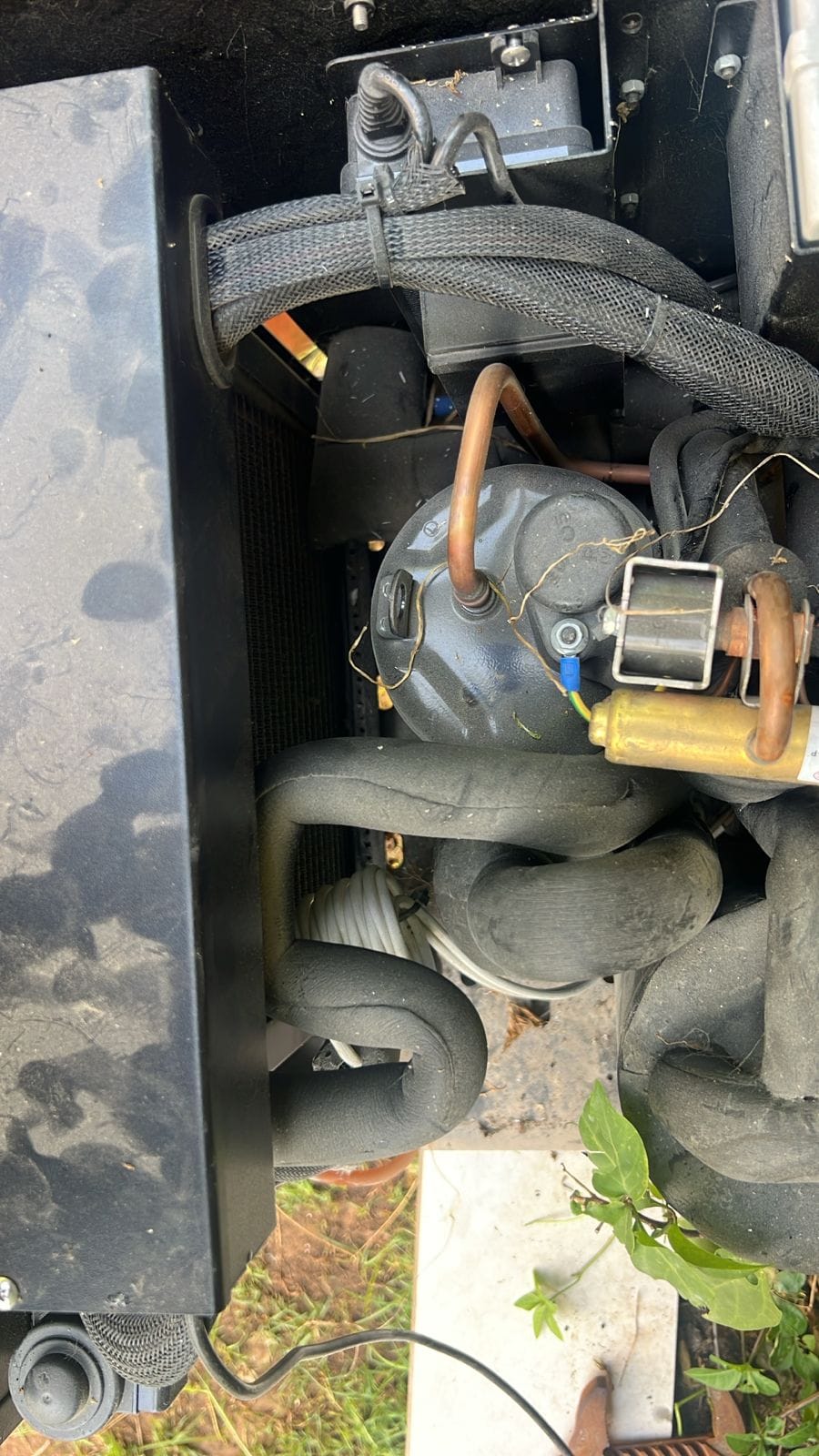
Opening the unit casing revealed a visible layer of dust, debris, and biological material across the condenser coil fins and shell. In a garden installation, airborne material including pollen, dust, and plant matter is drawn into the unit by the condenser fan and accumulates on the coil surface. This layer acts as insulation, reducing the rate of heat transfer from the refrigerant to the airstream. Even if airflow were fully restored by clearing the vegetation, the coil buildup would continue to impair heat rejection until cleaned.
Fault 5: Plumbing Layout Preventing Practical Water Changes
The water circuit had been plumbed without dedicated fill or drain valves. Performing a water change required working around the existing pipework, making the process slow and cumbersome enough that the owner had avoided doing it. This is a design and installation issue rather than a mechanical fault, but it directly caused the water quality problem by making routine maintenance impractical. Fitting two simple valves, one for fill and one for drain, would reduce a water change from a difficult task to a five-minute job.

The Work
With five root causes identified, the on-site work was prioritised by what could be addressed immediately and what required follow-up action from the owner.
Condenser Coil Clean
A thorough coil clean was performed as the primary immediate intervention. The casing was opened to expose the full condenser coil assembly, compressor, and refrigerant circuit. Accumulated dust and biological debris were removed from the coil fins using appropriate cleaning methods. The fin surface was inspected for physical damage, and none was found. The copper refrigerant lines and the compressor body were also inspected for signs of corrosion or refrigerant leakage. The system appeared refrigerant-intact with no visible oil staining at fittings or joints.
Filter Cartridge Removal and Replacement Advice
The blocked paper cartridge was removed and the owner was advised to fit a replacement immediately before returning the unit to service. The correct replacement specification was documented for the owner’s reference. The owner was also advised on replacement frequency: in a residential tub used daily in Dubai conditions, a filter cartridge should be inspected every four to six weeks and replaced at the first sign of reduced flow or visible saturation.
Water Drain and Refill Recommendation
Given the algae bloom and the six months of stagnant water, a full drain and tub surface clean was recommended before refilling. The owner was advised on appropriate surface cleaning agents that would not leave residues harmful to the refrigerant circuit or the user. Refilling with fresh water and establishing a routine water change schedule was noted as a prerequisite to re-commissioning.
Siting Correction
The vegetation around the unit was cleared to restore airflow on the intake side. A minimum clearance of 300mm on the fan intake and 500mm on the discharge side was advised, with a recommendation that the unit be relocated to a hard-standing surface away from planted beds if the vegetation could not be kept trimmed. The owner was advised to check clearances monthly during the summer growing season when vegetation grows quickly in irrigated Dubai gardens.
Plumbing Upgrade Recommendation
A proposal was made to fit a dedicated drain valve at the lowest point of the tub plumbing and a fill valve with a short hose connection at the top of the circuit. This modification would make future water changes straightforward and remove the practical barrier that had prevented the owner from performing routine maintenance. The owner accepted the recommendation for a follow-up installation visit.
The Outcome
At the point of completing the on-site work, the coil clean had been performed, the siting issue had been addressed by clearing vegetation, and the filter had been removed. The unit was not returned to full service on the same visit because the water required draining and the replacement filter had not yet been sourced by the owner. However, the five root causes were fully identified, documented, and communicated.
The owner had been on the verge of purchasing a replacement chiller under the assumption that the original unit was defective. Post-diagnostic, it was clear that the hardware was functional and that all five failure modes were the result of installation and maintenance decisions rather than product failure. A replacement unit installed in the same location, with the same filter routine and plumbing setup, would have developed identical problems within months.
Once the filter replacement, water change, and plumbing modifications are completed, the unit should be capable of reaching and holding its target temperature of 4°C in normal Dubai residential conditions, subject to appropriate ambient temperature management for the installation position. If you are dealing with a similar situation, the Euphorium repair and installation service covers full diagnostics of this type on site across Dubai.
Why Dubai Conditions Cause This
This combination of faults is not unusual in Dubai. The climate, the way units are typically purchased and installed, and the maintenance habits that develop around self-imported equipment all contribute to a predictable failure pattern.
Dubai’s summer ambient temperatures regularly exceed 42°C outdoors. ASHRAE guidance on refrigeration system design makes clear that condenser heat rejection efficiency drops significantly as ambient temperature rises. A chiller rated for operation at 35°C ambient will work progressively harder at 40°C, and may be incapable of reaching its target temperature at 45°C if the condenser is obstructed or fouled. In Dubai, this means that every degree of condenser efficiency lost to blocked airflow or coil buildup has a larger impact than it would in a temperate climate. The margin for error is simply smaller here.
Humidity in Dubai, particularly during the late summer and autumn months, accelerates biological growth in any standing water. A tub of water left unchanged for six months in this climate will develop algae regardless of the quality of the unit. This is not a product issue. It is a chemistry issue that requires a maintenance response.
Garden installations are particularly vulnerable to the siting and fouling problems documented in this case. Dubai’s irrigated residential gardens create a microenvironment of higher humidity and fast vegetation growth that is ideal for accelerating both biological fouling in the water and debris accumulation on the condenser. Units placed on hard standings with clear surroundings consistently show fewer fouling-related faults than units positioned inside planted beds.
The direct-import market for cold plunge equipment has grown rapidly across the UAE. Units arrive without commissioning support, without maintenance schedules, and without documentation tailored to local climate conditions. The owner in this case had no reference for what routine maintenance looked like. Every fault identified was preventable with basic guidance at the point of installation. This is one reason why professional cold plunge installation in Dubai that includes a commissioning and maintenance handover has practical value beyond the physical setup work.
How to Prevent It
The five faults in this case study are all preventable. The following steps apply to any residential cold plunge chiller installed outdoors in Dubai.
Siting
Position the chiller on a hard standing surface with a minimum of 300mm clearance on the condenser fan intake side and 500mm on the discharge side. Do not install inside planted beds. If vegetation is present nearby, trim it back monthly during the April to October period when plants grow fastest in irrigated Dubai gardens. Check that nothing has fallen onto or against the unit after wind events.
Filter Maintenance
Inspect the filter cartridge every four weeks. In Dubai’s dusty environment, outdoor units can clog a filter faster than the manufacturer’s schedule assumes. Replace the cartridge as soon as flow reduction is noticeable. Keep one spare on hand so replacement is not delayed by a sourcing wait.
Water Changes
Change the tub water every four to eight weeks depending on usage frequency, ambient temperature, and whether a UV or ozone sanitation system is fitted. In Dubai’s warm months, microbial growth accelerates in warm water. A tub used daily without sanitation will require more frequent changes than a tub with active sanitation. Fit a dedicated drain valve and fill connection to make water changes quick enough that they actually happen.
Condenser Coil Cleaning
Clean the condenser coil at least every three months for outdoor garden installations. In dusty periods, such as during shamal wind events, inspect sooner. A visual check takes two minutes. If the fin surface is visibly coated, clean it before the unit’s next extended run cycle. Coil cleaning does not require disassembly of the refrigerant circuit and can be performed as part of a routine service visit.
Annual Professional Service
A full annual service, including refrigerant pressure check, electrical terminal inspection, and water circuit inspection, will identify developing faults before they compound. Units that have never been serviced professionally, like the one in this case, tend to accumulate multiple simultaneous issues that are harder and more expensive to address than individual faults caught early. The Euphorium service and repair team covers routine annual maintenance across Dubai residential and commercial installations.
Key Takeaway
A cold plunge chiller displaying a 19-degree gap between set temperature and actual water temperature is not necessarily a failed unit. In this Dubai residential case, the chiller was structurally intact and refrigerant-complete. Five compounding maintenance and installation failures, blocked condenser airflow from vegetation, algae-contaminated water, a never-replaced six-month-old filter cartridge, condenser coil fouling, and impractical plumbing preventing water changes, had collectively eliminated the unit’s cooling capacity. Each fault was individually correctable. Together they produced an outcome the owner mistook for hardware failure. In Dubai’s outdoor installation environment, condenser airflow and filter maintenance are the two highest-priority routine tasks for any chiller owner. Neglecting both simultaneously, as happened here, removes the two main pathways by which the refrigeration cycle can function efficiently. Owners of direct-import units with no local service history should treat a professional diagnostic, available through euphorium.ae, as a commissioning step rather than a last resort.
Frequently Asked Questions
Why is my cold plunge chiller running but not cooling the water in Dubai?
The most common causes in Dubai outdoor installations are blocked condenser airflow, a clogged filter cartridge, or a fouled condenser coil. Any one of these reduces cooling capacity. All three together can prevent the unit from cooling below ambient temperature even while the compressor and fan are running. A diagnostic visit will identify which faults are present and in what combination. Contact Euphorium on WhatsApp to arrange one.
How often should I change the water in my cold plunge tub in Dubai?
Every four to eight weeks for a daily-use tub without UV or ozone sanitation. Dubai’s warm ambient temperatures accelerate bacterial and algae growth in standing water. If the tub sits unused for extended periods, change the water before returning to use regardless of elapsed time. Fitting a dedicated drain and fill valve makes water changes quick enough to do consistently. Water quality directly affects filter life and long-term plumbing condition.
How much clearance does a cold plunge chiller need outdoors?
A minimum of 300mm on the condenser fan intake side and 500mm on the discharge side. In practice, more clearance is better, particularly in Dubai where summer ambient temperatures reduce the refrigeration cycle’s heat rejection margin. Garden installations inside planted beds frequently develop airflow problems as vegetation grows. Hard standing surfaces away from planted areas are the preferred installation position for outdoor chillers in Dubai residential properties.
Can I buy a cold plunge chiller direct from China and install it myself in Dubai?
The hardware can be purchased and physically connected, but self-imported units arrive without climate-specific commissioning guidance, local maintenance schedules, or after-sales support. The faults in this case study are typical of self-imported units installed without professional setup. A professional installation through Euphorium’s cold plunge installation service includes siting assessment, filter and water change schedules, and a maintenance handover that prevents the compounding failure pattern seen here. A rental unit is also an option if ownership commitment is uncertain.
Research on thermal stress responses and cold water immersion is documented in peer-reviewed literature including studies published in peer-reviewed journals indexed by PubMed. Refrigeration system performance standards referenced in this article follow guidance from ASHRAE Handbook: Fundamentals.